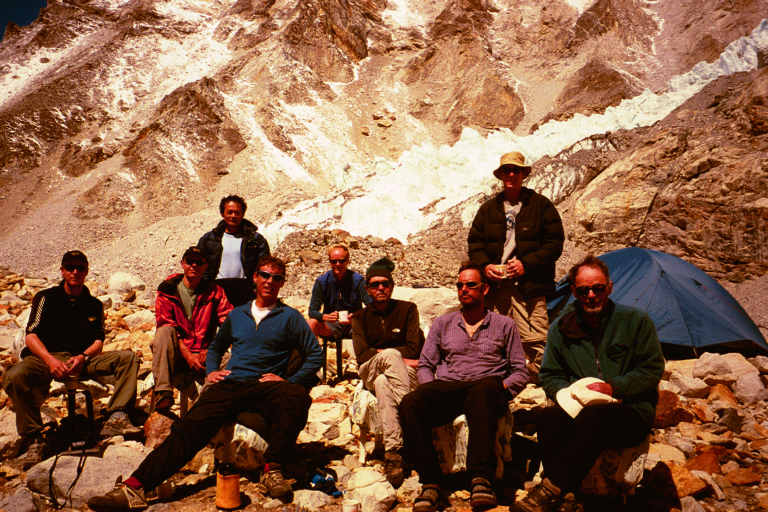
Makalu (8485m, 27939ft) is the fifth highest mountain in the world, after Everest, K2, Kangchenjunga, and Lhotse. It lies on the border of Nepal and Tibet about 20k east of Mount Everest. It was first climbed in 1955 by a very strong French party including the legendary Lionel Terray. Only five of the first 16 expeditions to Makalu were successful, and it had received only 167 ascents by the end of 2000 (versus 1172 for Everest). No one had climbed it twice (Everest has had 299 repeats). Typically, only 2 or 3 expeditions attempt Makalu each year, but this year there was a record number of about 7.
In January, an expedition I had planned for the spring of 2001 to Diran Peak in Pakistan fell through, and I had to look for an alternative. A search of the web revealed that the New Zealand company, Adventure Consultants, was organizing a nonguided expedition to Makalu led by Guy Cotter. After I had some e-mail contact with the company, Guy telephoned me from the Aconcagua base camp on February 3, and I joined the expedition. At that time, according to what Guy told me, it had only three members (Jean-Claude Latombe, Robert Stevens, Takashi Ozaki) and Guy. When we started, less than 2 months later, the expedition had 9 members, including a camera crew, plus a base camp manager.
Camera man and base camp manager: Hamish Emerson (Guy, Takashi, and Bryan were also part of the film crew).
Trekkers: Katie Deans, Jonell Mills, Alex Kerr, Lawrence Kerr (the last two are sons of Keith).
High altitude Sherpas: Lhakpa Dorje Sherpa (climbing sirdar), Pasang Namgyal, Tenzing Gyaltsen, Pema Rinzing.
Expedition Sirdar: Ang Tshering Sherpa.
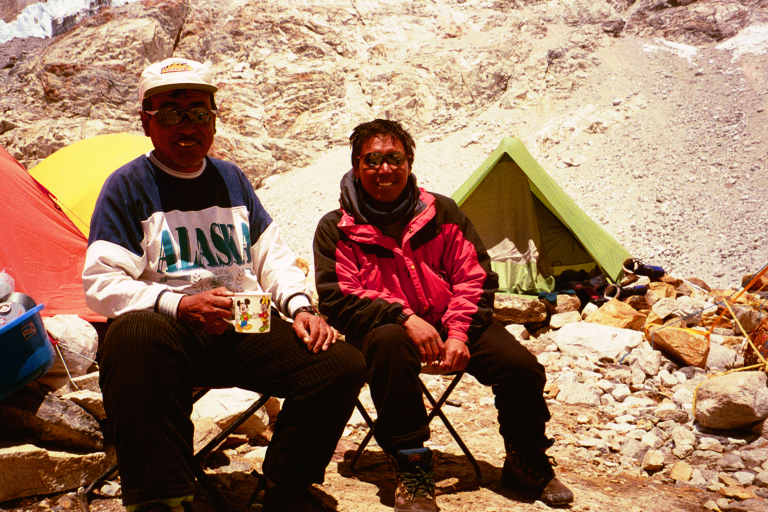
Most of the text that follows is taken verbatim from the journal I kept during the expedition.
Went to Timal Adventure Trekking [my usual trekking agency], and talked to Thulo Tamang and the Sanu Kancha Tamang. Business is not good. I suggested they need a web site. Perhaps I can help them...
Guy looked at my gear -- we have some different preferences but no problems.
Went to dinner with everyone who is here (all but Kerrs). We gave the two from the film crew a hard time. We don't like this hardships and adventures type stuff. On the other hand, they claim they are examining the psychology and science of high altitude mountaineering. [I'm skeptical of that! They are working for a TV documentary group based in Dunedin, NZ. Their documentary will be shown world wide by International (National) Geographic.]
We (the expedition) had a meeting on the roof. While the camera whirred, Guy gave us a little talk. We have no doctor, but we can link quite quickly via satellite to various experts.
Finally I saw Gunjaman. He is building a second house for his extended family of 14. His father is 88 and his mother is 83. They never leave their village of Timal which is still a long walk from the nearest road. Now Gunjaman will trek no more (his children have persuaded him that he is too old). It was only an accident that he came to Kathmandu the same day as me, since he hadn't been here for six months. We discussed our six trips together.
Gunjaman said 8 men are working on his house, and are paid between 150R ($2) and 250R ($3.40) per day depending on their skill. It will take them about 8 weeks to build it, and it will cost about 90,000R ($1200).
[When Gunjaman was growing up, his village had no school, and so he is illiterate. However, he speaks his own Tamang language, Nepali, and some English, Hindi, etc.. He is as good at mental arithmetic as I am, and better, I'd guess, than 99% of the UM undergraduates. One of his sons is studying mathematics at the main Nepalese university in Kathmandu and works as a trekking guide during his holidays.]
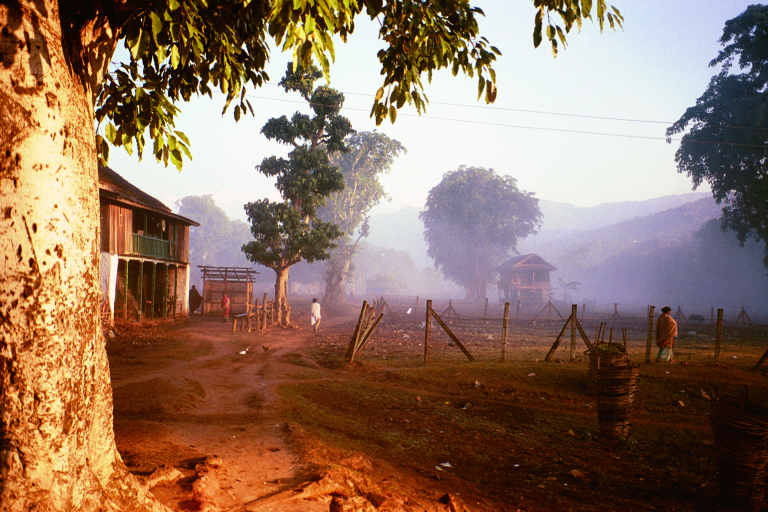
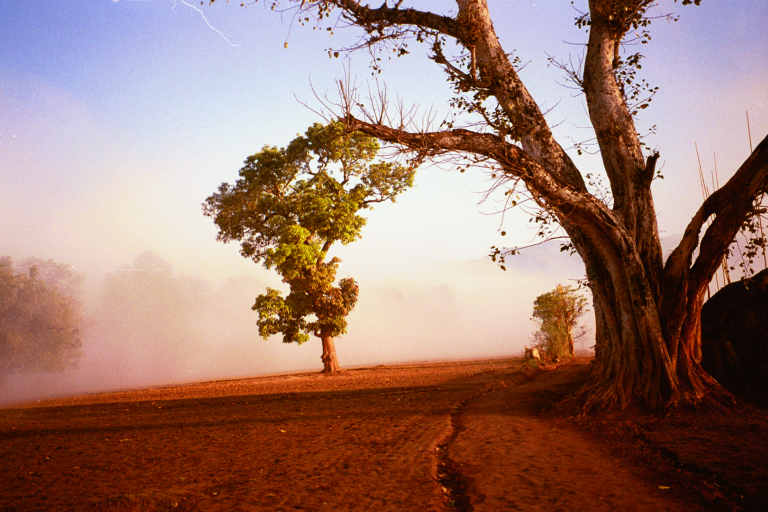
Reached Mani Banjang a little after 10. Had lunch. Found good spot to sit in shade of bamboos above a big camp site (soccer field), and read. Hamish showed up and we talked with some of the local kids, whose English was surprisingly good. Eventually wandered over to our camp site, and was happy find that four of us had been assigned tents of our own. I found it a short, but pleasant, walk--- good views, and interesting walking through villages. It was hot, but not as bad as I feared. A large Iranian party bound for Makalu arrived at the soccer field. There seem to be about 20 of them, and they always trek in a single line with only about 2 feet between them. We have over 45 porters. Before dinner we went down the town for a beer, and some of the others shot at a sign with slingshots they had bought. Eventually, Guy put a stone clean through the sign.
Guy said that Time Magazine sent someone to Everest base camp to write an article about how much garbage was there. But there is no garbage there, so he took a photo of Adventure Consultant's temporary garbage heap, and wrote the article anyway. [Why is the world so interested in the garbage, or the lack thereof, on Everest? Among all the world's evironmental problems, this hardly counts.]
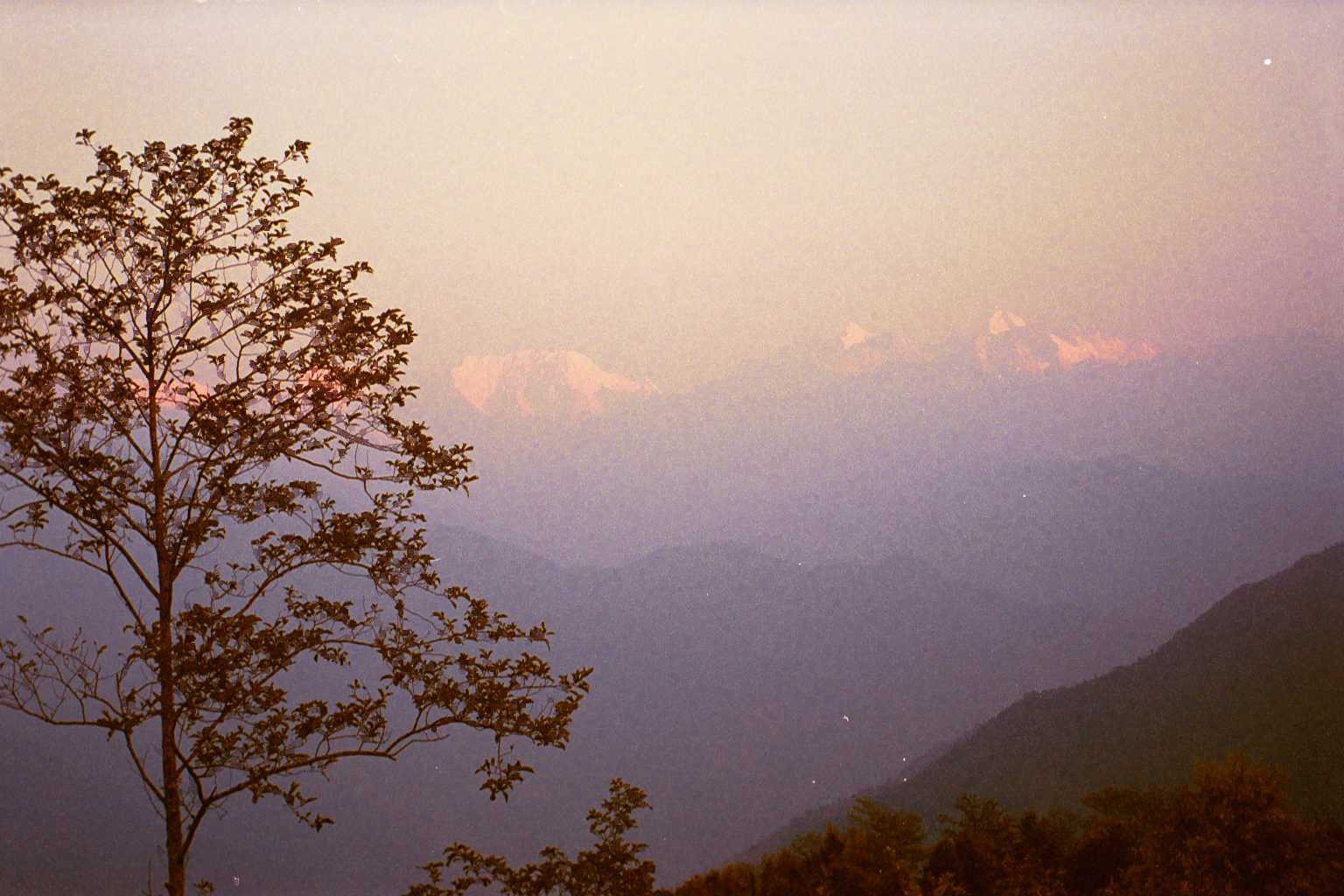
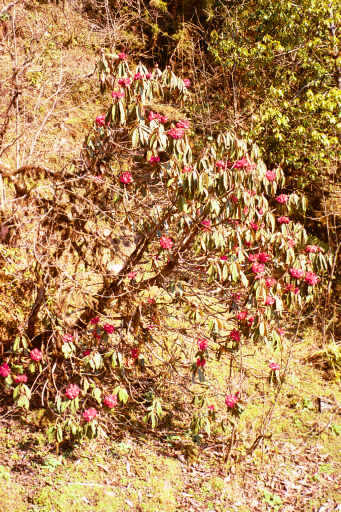
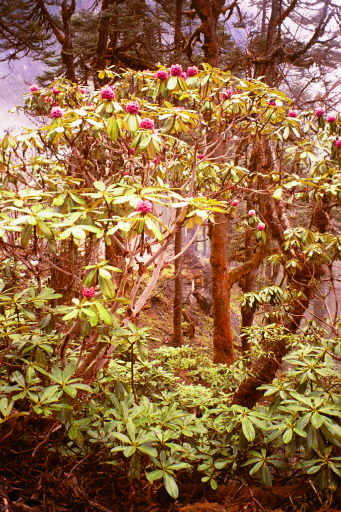
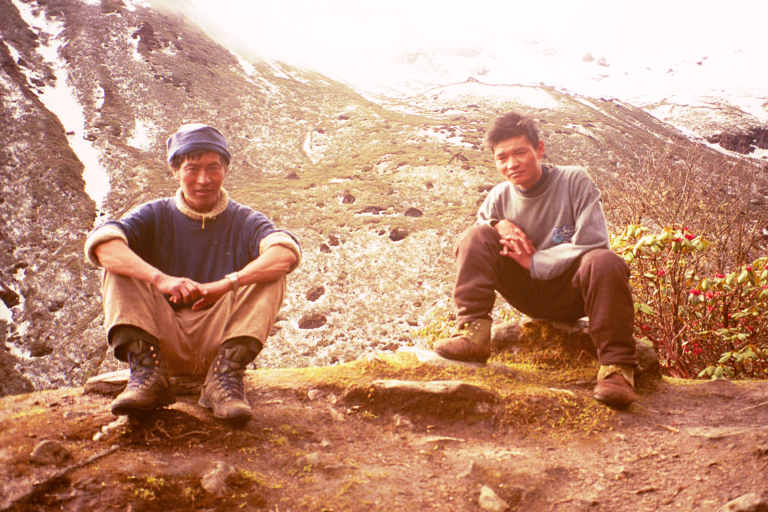
I left at 6:45, and ambled by myself for a while, and then with various people. Stopped for 2 hours at the highest point to read and admire the view. A few rhododendrons were in bloom. Then walked down to Num about 3pm. Probably walked for about 4 hours.
We discussed whether our group could maintain Iranian formation for even 30 seconds --- the consensus was no.
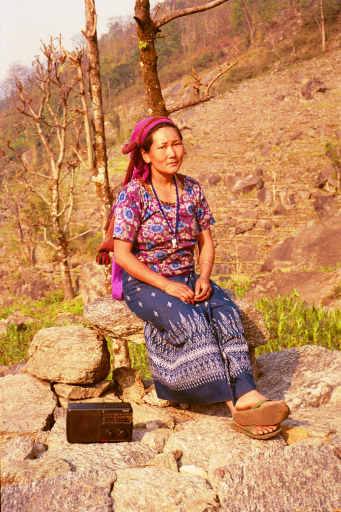
Reached the Arun river below Num at 7:30 and Sedua at 9:30. As I arrived 3 porters arrived carrying 90kg (200lbs) each(!), mainly beer. The rest of the members straggled in, followed by the porters. I spent the afternoon reading and drinking beer.
...I am enjoying the trek in except, as usual, I would rather be going faster.
There was quite a lot of haze, even in the morning. Left at 6:35 and walked up to a mani wall. There rested, and several of the others arrived. Reached Tashigoan at 9:45 and had a beer with Rob. The women trekkers and Keith and his two sons arrived, and we had an enjoyable lunch together. The others went with Takashi to see some famous bee hives that Takashi had filmed on a previous trip, but they didn't get a very good view. Tashigoan is our first Sherpa village; also the last permanent village we'll see.

To my surprise, I ran into a lot of snow after a while. Many porters for a big group were coming down, some with instep crampons. One female porter had fallen on the icy snow, and had cut her face when she hit the trees. She looked a little shaken. I continued up in the snow in my running shoes without significant problems, and reached Kaungma at 10:30. There was a hut with two Nepalese there. Had beer, my last --- 200R ($2.70). Rob and JC arrived after about 15 minutes. Two very young Tashigoan porters (boy aged 11, girl aged 15) arrived soon after carrying loads. They dumped the loads, and went tobogganing on the snow using plastic sheets. Keith's children arrived in 7 hours from Tashigaon (Lawrence, aged 17) and about 9 hours (Alex, aged 13) looking totally exhausted. The contrast with the Sherpa children was remarkable.
Porters arrived late, especially those with my bag. Thereafter I carried my tent (c 3kg) myself, because typically it would be fine in the morning but would rapidly get cloudy and cold in the afternoon.
It's a little disconcerting to be camped on snow and still have 5000m to climb.
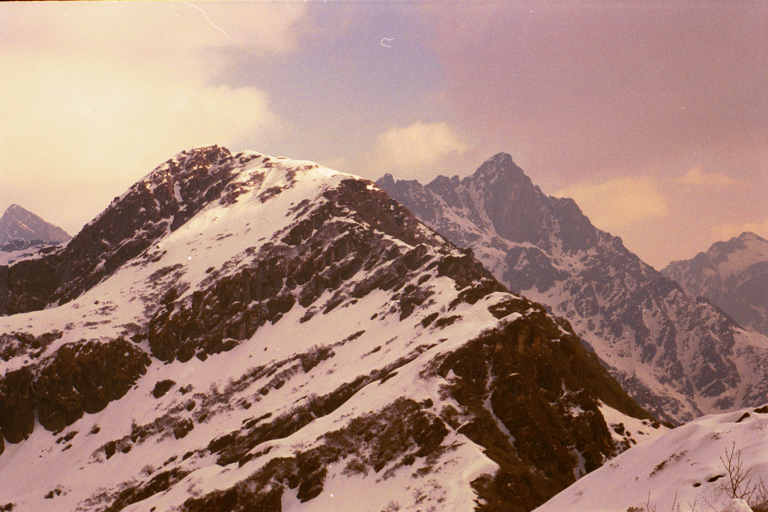
Reached Mumbuk just before 12, so it took me almost 5 hours, which is the guidebook time. There was some danger --- many places a slip on the icy snow would have been serious, and in some places the tracks were not good. Rob had worn climbing boots and crampons and was there about half an hour before me [all the way in to base camp from Num, one of the two of us would always reach the campsite first]. I pitched my tent, and took a nap.
There was snow on the descent through the trees, which made it unpleasant in light walking shoes. Then across the rock slides --- beautiful views of Makalu. [The ridge we had crossed sheltered the Barun valley from bad weather, which comes from the south, and the trail was largely free of snow all the up the Barun to base camp.]

Reached the bridge crossing the river in about 3 hours; had some lunch there and watched a helicopter land (this is where we stayed in 1996). Was opposite Nehe Kharka in another hour. Here Rob and I almost got lost by following the trail across the river, but we waited for some sherpas to follow. Reached the hut where we had lunch in 1996, but there was too much dung for us to camp there, and we carried onto a beautiful campsite about 20 minutes further on (5 hours). I was feeling a bit grungy from my cold early on, but I finished fast. Put up my tent (which I had been carrying) and relaxed.
About 3:30 (over tea) we heard that Alex was in trouble --- he was moving extremely slowly and was exhausted. Guy sent down some porters to carry him up to our camp. He arrived at 6:30, just on dark. The porters carried him only for about the last half hour (my pace). Although he is only 13, Alex weighs 170lbs. Fortunately, tomorrow is a fairly easy day to a little past Shershon to where our bags were helicoptered, and we spend a day there to acclimatize.
My cold has reached the coughing stage. I hope I can get rid of it in the next two days. It is making me feel a bit grungy.
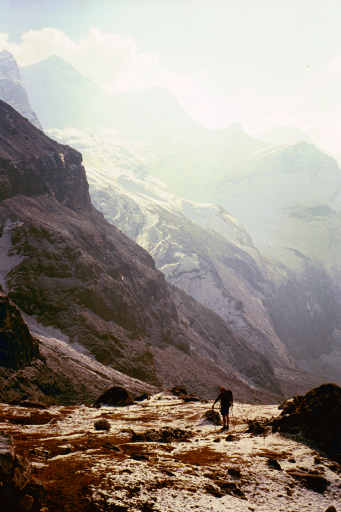
I set off at 7am, and reached Yak Kharka [=Yak meadow] at 8am. A Nepalese couple was living there, and I stopped for a cup of tea. The weather was still very clear, but the clouds were starting. I walked very slowly, but without stops except towards the end. I passed Shershon (4600m, 15100ft) at 11am, said hullo to Katie who had got there before me, and continued on. I reach our campsite near the American base camp (c4700m) at 12:03 --- as usual, the walk had taken me about 5 hours. Rob arrived about 10 minutes before me and most of the rest about an hour later. Put up my tent and enjoyed its warmth. My cold had given me a very unpleasant severe sore throat during the walk. I am a little worried --- it is reminiscent of 1995 when I had severe coughing problems.
Guy radioed while we were having tea, and he and Hamish and Keith arrived an hour or two later.
An American expedition is at the south Makalu base camp attempting the difficult southwest ridge of Makalu. One of their 6 climbers has already left with severe altitude sickness. On the walk in, they had to use their Gamow bag to save a Korean climber with altitude sickness who had been left behind by his companions near Shipton pass . The other Koreans seemed unconcerned by his near death: apparently, they didn't much like the guy anyway.
Each evening, we have dinner together, which takes about one and a half hours. The food is very good.
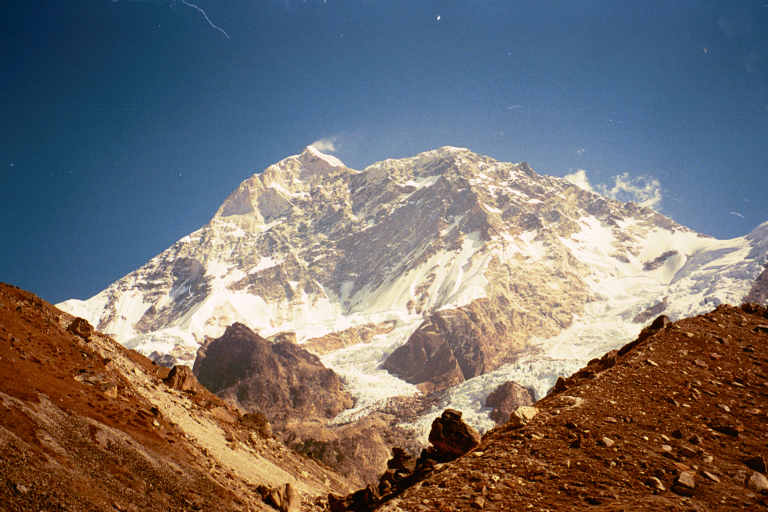
Discussed the tragic events of 1996 with Guy. [At the time Guy was nearby attempting Pumori; when the tragedy unfolded he went to Everest base camp and took charge of the rescue.] He said that in all the accounts he has read, people tell lies ...
Weather was cold, breezy, and snowy in the afternoon. My cold continues: cough, sinuses.
It was a very good day for me: a good walk and my cold didn't bother me; in fact it feels a little better. It is great to be at base camp. Hamish's GPS gave its altitude as 5700m (18,700ft).
Many of the others have headaches or lightheadedness from the altitude, and JC skipped dinner. No one had a big appetite for dinner. I feel quite good except for cold.
I am reading a book of short stories of Chekhov: "True happiness is impossible without solitude. The fallen angel probably betrayed God because he longed for solitude, which angels do not know."
Snowed in the afternoon.
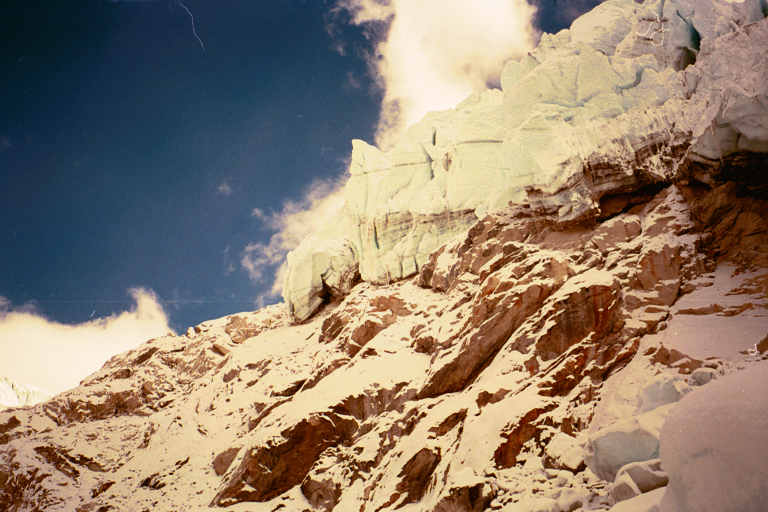
Talked to the members of the Chilean expedition. They said they had fixed a little rope over an icy boulder, but otherwise said there was no difficulty to their camp 1 at 6200m. They had come down from their camp 2. Seemed nice guys --- asked me whether I was a guide [this proves they were nice guys].
After lunch, Guy told us his plans. On Sunday 15th puja. Then:
So (as Jean-Claude put it) we climb the mountain five times.
While we are trooping up and down the mountain, the four climbing Sherpas will be fixing the ropes and carrying up the tents and oxygen (which I, at least, plan to use above Camp 4).In the afternoon, I prepared some of my gear and got Bryan to make some loops for me to connect me to the fixed rope (with a carabiner and Petzl ascender). I have never seriously used fixed ropes before --- Makalu seems an interesting place to learn.
Also, I'm somewhat unhappy with the inconvenience and hassle of a big expedition. Instead of making myself coffee and breakfast when I wake, I have to walk over to the kitchen tent and scrounge some when the kitchen staff wake (about 7:30). On the mountain I'll have the inconvenience of sharing a tent. Finally, I seem to be acclimatizing faster than all these hotshots. I've been the only one healthy and energetic enough to go for long walks. Many of the others still have headaches and don't feel very well. The same goes for the three groups that got here before us: the Koreans and Spanish don't seem to have gone anywhere, and the Chileans have only set up a camp 2. On Mustagh Ata, I climbed the mountain in only 10 days from base camp at 4400m, with no to-ing and fro-ing, but Makalu is 900m (2950ft) higher and a much more difficult mountain; I'm concerned that Guy's regimen will only succeed in exhausting me.
In the morning we had a puja---a ceremony in which the Sherpas asked permission from the Gods to climb the mountain. It consisted of putting up prayer flags, chanting, a fire of juniper, and some ritual eating and dispersal of food. During the ceremony, it grew very cold and started snowing; perhaps, not a good omen.
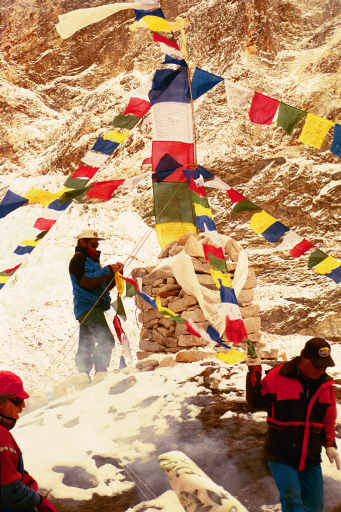
The Chileans came over, and we had a pleasant chat.
After lunch Katie and Jonelle left for the south Makalu base camp to hitch a ride out on a helicopter to go trekking in the Khumbu. Katie had had a persistent altitude headache at base camp, and so they had abandoned their plan to cross the three 6000m cols to the Khumbu.
Guy went to a meeting with the other teams, and came back with words of praise for the Chileans and anger for the Koreans (as being arrogant and uncooperative). The Chileans and Koreans had agreed to have their sherpas work together fixing ropes, but the Koreans refused to allow us to join the consortium, or even to use their ropes. [As it turned out, this was not a problem: the Korean ropes were so lousy that no one wanted to use them anyway.]
It was warm and sunny in the afternoon.
Today, we would be climbing to Camp 1 and back. Guy told us we wouldn't be leaving until 8:30, but I worried that, if I left at 8:30, I would end up walking down a crevassed glacier unroped in the late afternoon with soft snow, and so I decided I would try and leave after the 7am breakfast. Confusion! Guy had told us breakfast would be at 7am but had told the kitchen staff that bed-tea was at 7am. Eventually I left at 7:35, about 45 minutes behind the sherpas and hour before I was supposed to (another black mark).
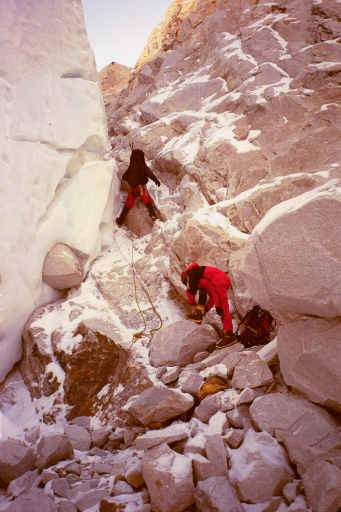
Climbed loose rock between the seracs. Had fun jumaring up a 10m fixed rope over an icy boulder.
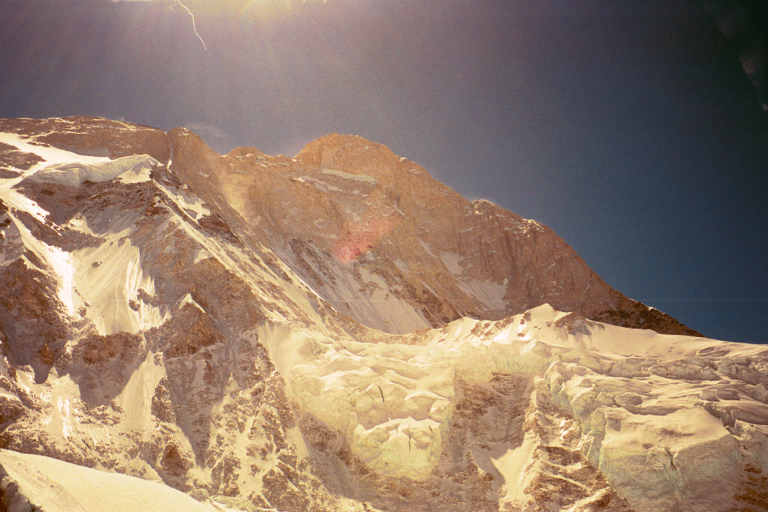
Followed the sherpa tracks in the new snow, and then onto the easy snow. It was awesome to be alone up there with Makalu's giant W face to my right.
The fun diminished when I eventually saw 12 climbers ahead of me --- the Koreans and our 4 sherpas. Continued up crevassed slopes to below the final slopes to camp 1 at about 10:35 (c6100m). There was a traffic jam on the fixed ropes there, so I returned down.
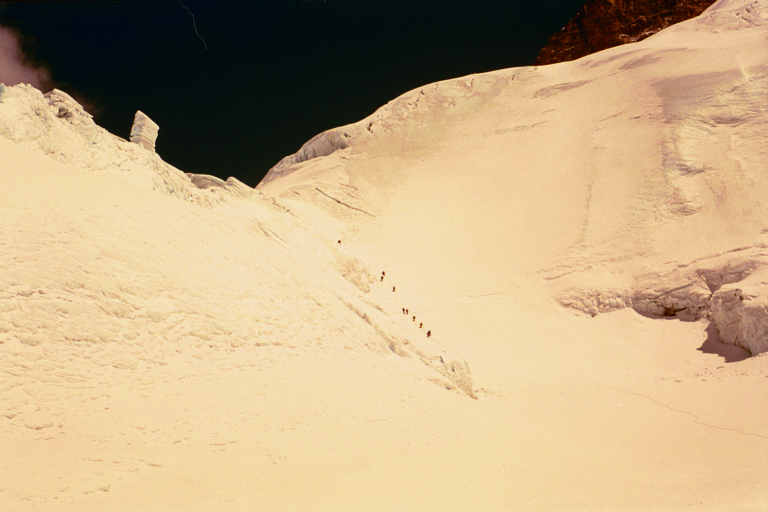
By now the Chileans, Spanish, and the others in our group were coming up.
I arrived back at base camp quite tired at 1pm. Saw the Chileans. Rested.
This day the Sherpas were supposed to carry to Camp 1, but they went to Camp 2 by mistake.
Guy had fruitful conversations with the Austrian and Iranian parties (who had arrived after us) --- we work together (or, rather, our sherpas work together) on the fixed ropes. We have 500m of fixed rope, and the Austrians gave us 400m more. A trekker with the Austrians had suffered a stroke and had to be evacuated; also a climber was evacuated (K & J went on their helicopter).
Temperature of 16F in morning. Weather was sunny but windy in the morning, sunny at midday, and later cold. Many of the others showered, but I rested hoping to get rid of the cold that ails me.
Tomorrow, we go up to camp 1 for 2 nights, and then perhaps to camp 2 for 1 night, before returning to BC for 2 days. Our strategy is to go slowly and acclimatize well. I worried about how long this was all taking --- what happened if we got a big storm? Guy said that even a large (6 ft) snowfall would clear in a few days.
I should be excited, but I'm a bit worried about not being completely well. First signs of cold began on 6th (11 days ago). Most of the others, who set off with colds, shook them off during the trek in.
Reached Camp 1 at 1pm tired and in bad weather. The sherpas had erected 5 tents, and Mark assigned me one --- a big Mac Pac --- which I shared with Takashi. I spent the afternoon resting.
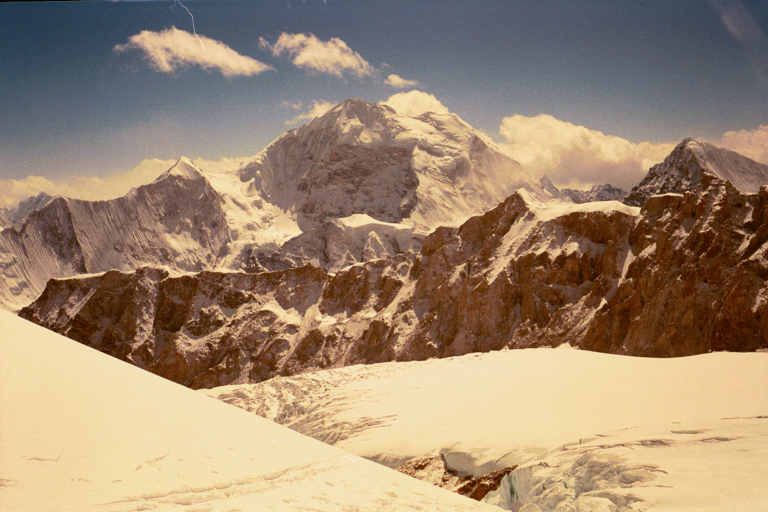
As usual, I was packed first, and so was rewarded with having to break trail for the others. I stopped before the fixed ropes to put on my crampons and other gear, and to wait while those who had passed me climbed the fixed ropes.
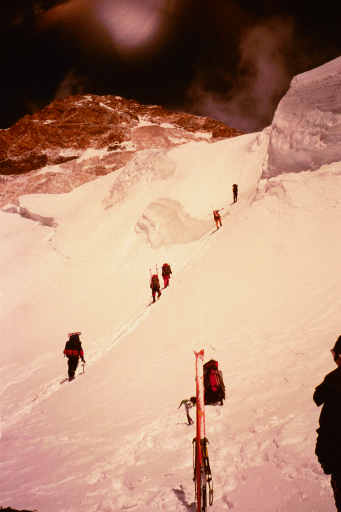
Finally left up the fixed ropes before only Rob and Takashi. Climbing the fixed ropes was hard work because they were long, the last part was very steep, and the footsteps in the ice were barely sufficient. As I neared the top, the wind revived, and it became extremely cold. From the top of the ropes, it was only a plod in a gusty high and very cold wind to the camp --- I had to put on my heavy down jacket. Guy helped me take off my crampons and install myself in my tent. Takashi struggled in about 10min after me.
Takashi has had an altitude headache ever since we left Tashigaon. Rob also has some altitude problems, and so the two of them went down about midday. Guy vomits for the second successive day, but otherwise seems O.K..
My cold continues to worry me --- much coughing, and now pain from the sinuses at the back of my nose.
After Takashi leaves, I have the large Mac Pac tent to myself. The food I have to eat is execrable: no breakfast food, 4 identical Japanese soups, 2 barely edible cheesy somethings. I am angry, especially when I discover that everyone else (including Guy) had grabbed all the good food.
I spent the day reading, with rare excursions outside for the view.
At tea, Guy talked about the Adventure Consultants 1995 Everest expedition. They reached the South Summit (8763m,28750ft), and Guy continued. The snow on the top of the ridge was bad so he kept on the face below the top of the ridge; then a 20--30 foot wide cornice collapsed behind him [it "unzipped" along his footprints]. Since it was late (12:30) they decided to return. Chantelle Mauduit [a client] collapsed, so (I think) Guy gave her his oxygen and helped her down. Eventually, the Sherpas took over, while Guy helped Doug Hansen [a client, who died the next year near the summit of Everest], who was falling over every step. It got dark, but they found a bottle of oxygen left for them by Ed Viesteurs [an AC guide] --- this allowed him to put Hansen on 4 litres per min, so that he now fell over only every second step. Guy got back to the camp at 9:30pm, and spent the night with Rob Hall keeping Doug Hansen and Chantelle Mauduit alive.
Tomorrow we go to camp 2; then we rest one day; then we go Makalu La and return to base camp in one day. In the afternoon we packed our own food for the excursion.
Began snowing after lunch, and by 5:30 there is a couple of inches on the ground, but it doesn't look serious.
I am reading Klemperer: I Will Bear Witness 1933-1941 (A Diary of the Nazi years): "I am ploddingly and hopelessly reading Crebillon... I do not believe that I shall once again find the youthful boldness for a grand and blind general survey, I am drowning in material and scruples..." July 28, 1933 --- he was only 52 at the time!
We have a communications tent where we can send and receive e-mail via satellite (for $7 a shot). Whenever we are in base camp, the tent is in constant use. Also Keith has a phone, and typically spends more than an hour per day on it. I resolutely refuse to have anything to do with communications. At least we use solar panels to charge the batteries --- the Chileans have a petrol generator. Our boom box is playing pop music almost continuously all day. Except for all that, base camp would have been a pleasant spot.
I'm getting a bit bored, as I thought I would, with all the sitting around at camps that are too high to be comfortable; also, with the communal meals, where everyone seems to have run out of new things to say. Concerning the climb, it will be spectacular to get to Makalu La. If I can make a strong attempt on the summit, I think I will judge the trip a success.
The method of climbing --- no climbing rope, only fixed ropes--- is new to me, but I'm starting to get the hang of it. I think will be able to hold my own (especially using oxygen above Camp 4).
Keith's decision to pass me in a dangerous fashion only 20m from the top of the fixed ropes is inexplicable to me. We had left base camp at about the same time 3 hours earlier, and sometimes he had been ahead and sometimes I had been. So what had induced him to try to pass me there when we were only a few minutes from easy ground?
Something in Keith's knee had popped, causing him to fall --- he hadn't injured it in the fall. Guy diagnosed the injury as serious --- in particular, his kneecap had much more movement than it should --- and told Keith he would have to return to base camp. Keith wanted to go to Camp 2 and hope that it would heal with rest. Guy escorted Keith down.
[Keith returned to base camp without difficulty, where a doctor with the Chilean expedition confirmed Guy's diagnosis. Keith was escorted down to the south Makalu base camp by two sherpas the next day. He experienced considerable pain during the descent and took 8 hours. The next day he went by helicopter to Kathmandu. The day he descended, a Korean who had contracted pulmonary edema between camps 1 and 2 also descended. but he couldn't afford the helicopter.]
After Keith had set off down with Guy, I climbed from camp 1 (c. 6300m) to camp 2 (c. 6750m). Apart from on the fixed ropes, I pretty much kept up with everyone else.
Beautiful windless morning. I leave at 8:30, after everyone else. Beautiful walk across shelf, then up easy slope to the fixed ropes (9:30).
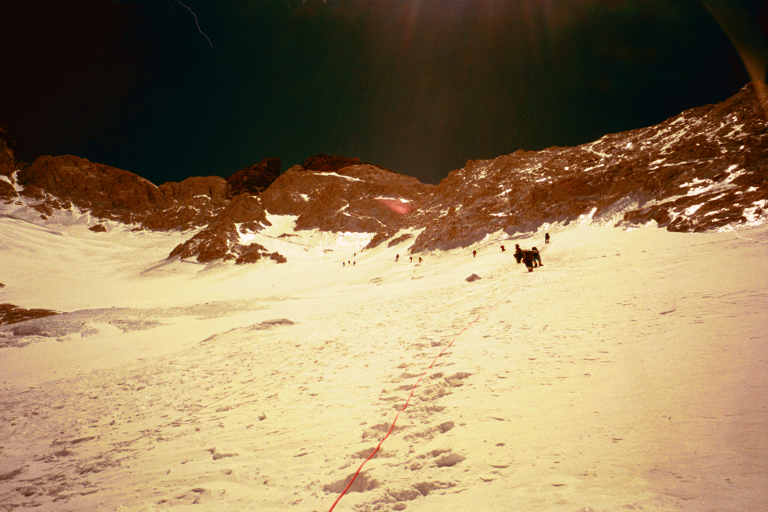
Climbed easy fixed ropes to a rock (10:40). Waited for Willie. My estimate from his altimeter was that I had climbed about 270m (900ft) (so about 7000m, 23000 ft) --- less than half-way to the La. Nevertheless, I descended so that I could get back to BC without exhausting myself.
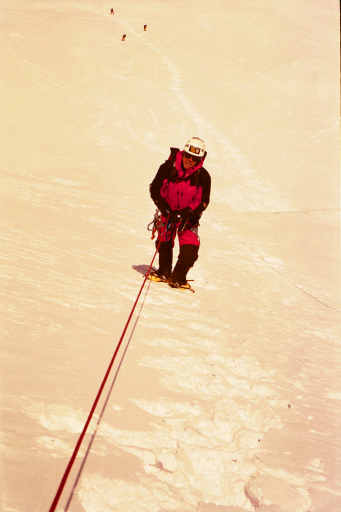
I made a very slow descent, and didn't get back to BC until 4pm.
I had my usual problems on the lower fixed ropes: the usual one was frozen into the ice and I couldn't get my figure of eight (descender) onto it. Instead I descended a rope Guy had put in, but the second section was also frozen into the ice. I contemplated crossing to other rope, but the memory of Keith's fall inhibited me. Fortunately, a sherpa going up on the other rope freed it for me. Then I felt exhausted on a small traverse. I was extremely tired by the time reached base camp --- I had to stop and rest twice while crossing the almost flat final slope to the camp.
Near the bottom, I discovered I've left behind my orange bag with the things I wanted to bring down --- ascender, glasses, ... --- as well as my wallet... Takashi remembers seeing it in the vestibule, and Guy radioed the Sherpas to put it inside my tent.
The others, following the same logic as me, stopped about 200m below the La and made a rapid descent: most were in BC only shortly after me.
A bad day for me --- 270m (900ft) in 2 hours 10 minutes starting from 6750m (22150ft) isn't bad, but on Mustagh Ata I snow-shoed up 1200m of trackless snow in 6 1/2 hours starting from 6200, and my exhaustion on the descent was ominous. The big test is going to be the climb (with personal gear) from camp 2 (6750m) to camp 3 (7400m). The first 450m is easy, but the final section is 200m up a steep icy couloir. I need to regain my enthusiasm for the mountain.
The point of Guy's regimen is that one should feel better, and climb faster, each time one goes up the mountain, but this time I was slower and felt worse than the previous time.
Guy talked about 1996 again. When Neil Beidleman [guide with Mountain Madness] got down he said that lots of people did bad things up there...
For myself, if I was feeling as good as I was on Mustagh Ata I would be quite confident. However, on my last trip up the mountain, despite all the acclimatization, I didn't feel that good. I just have to hope that I rise to the big occasion. These trips up and down the mountain are exhausting me. Since, unlike everyone else (including Guy and Takashi), I haven't had a single symptom of altitude sickness since arriving at base camp, I should surely be resting.
In 12 days we should all be back at base camp and packing to leave.
Warm, but partly cloudy in the morning; light snow or rain in the afternoon.
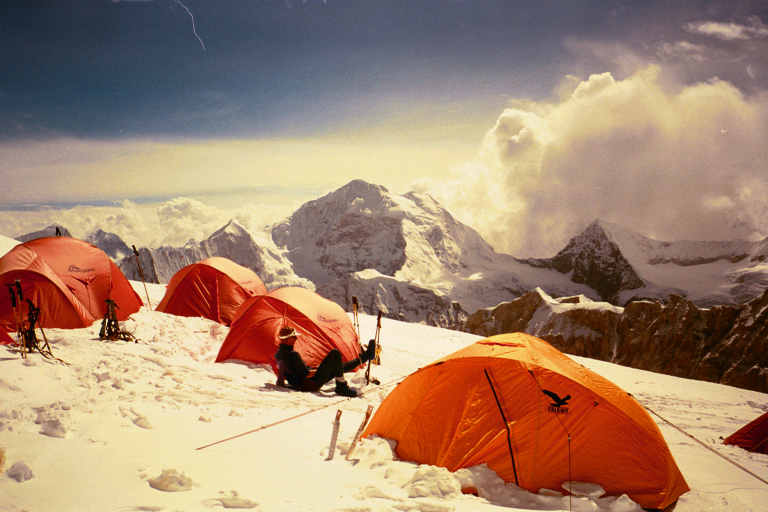
The Adventure Consultant's "high altitude food" is very bad --- except for the porridge and the 2 muesli bars we are allowed per day, most of it has a very high fat content 50--80%, which is the opposite of what it should be. [To be useful, food eaten at high altitude needs to be almost all carbohydrate; eating fat, even when you can, does you no good, because you don't digest it.]
There is something strange with my fluid balance. I drank enough water last evening so that I urinated a couple of times during the night. Nevertheless, I was very dehydrated in the morning. To Takashi's astonishment, I drank 4 one-pint mugs of weak tea. Nevertheless, my mouth was dry when I set off. I drank a pint on the climb, and more when I returned. Nevertheless, I didn't pee until 2pm.
Talked with Jean-Claude and Guy about options. I just want to get back to Kathmandu (math) and Ann Arbor (more math).
It doesn't say much for Guy's acclimatization regimen that Jean-Claude and I, who had both reached the summit of Mustagh Ata (7545m) without significant difficulty only 8 months earlier, were unable to climb over 7000m on Makalu. Since, unlike everyone else, I had no symptoms at all of altitude sickness, five trips up the mountain were surely excessive for me. If I had been able to make fewer trips, and been able to spend more time resting (possibly at a lower altitude than our base camp, which was unusually high), I should have been able to reach camp 3 and join the summit bid.
News: The Koreans and Spanish made unsuccessful bids on the summit --- the slopes before the final (French) couloir to the summit ridge were too icy. The Spanish reached c8300m, where they were stopped because they hadn't climbed the French couloir. Several parties are now moving up to attempt it.

Guy and Ang Tshering arranged two porters to carry my gear out for me. They were very friendly and helpful --- one (a Sherpa) had been working for us (going down to Nehe Kharka for fresh vegetables), and the other (a Rai) for the Chileans.
An indication of my deterioration: on the way in, I had climbed from the south Makalu base camp to our base camp (4700m to 5700m) in 5 hours and 20 minutes, but it had taken me almost as long, 4 hours and 30 minutes, to descend. After 23 days of Guy's regimen, I was slower at high altitude than when I started.
JC, the 2 porters and I left at 6:35am. In the morning, the weather was perfect. I stopped every hour for a rest and a drink (we didn't bring a stove, so hydration was difficult). The walk in the morning was one of the most beautiful of my life.
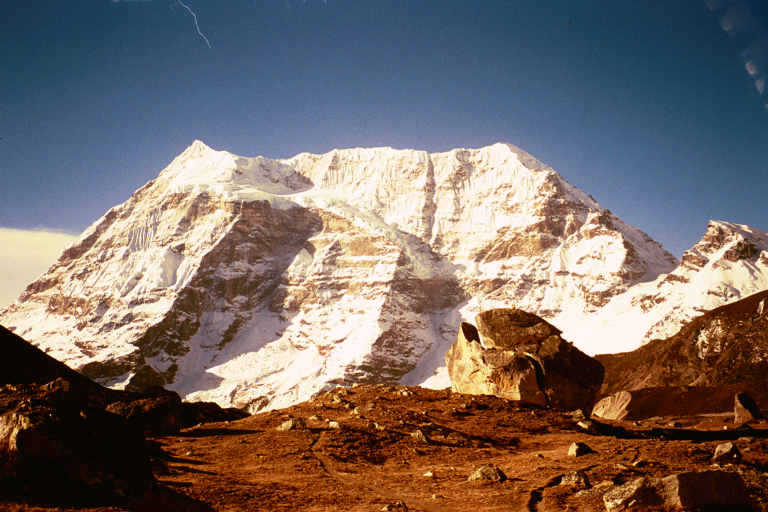
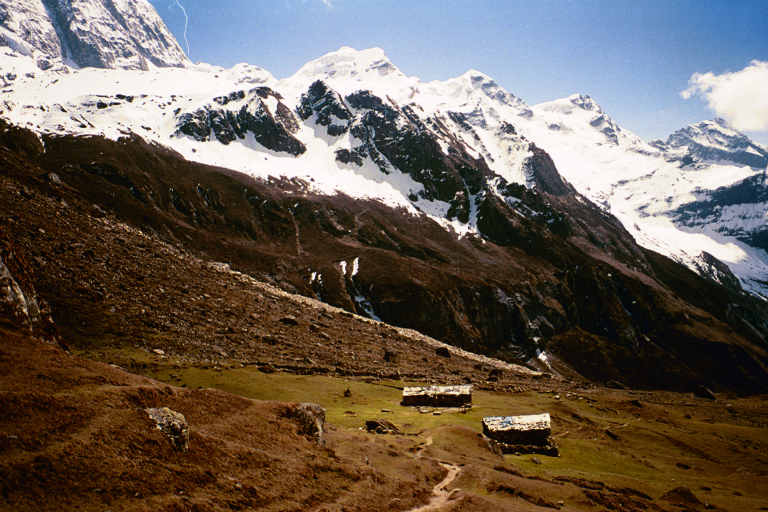
Later it clouded over and became foggy.
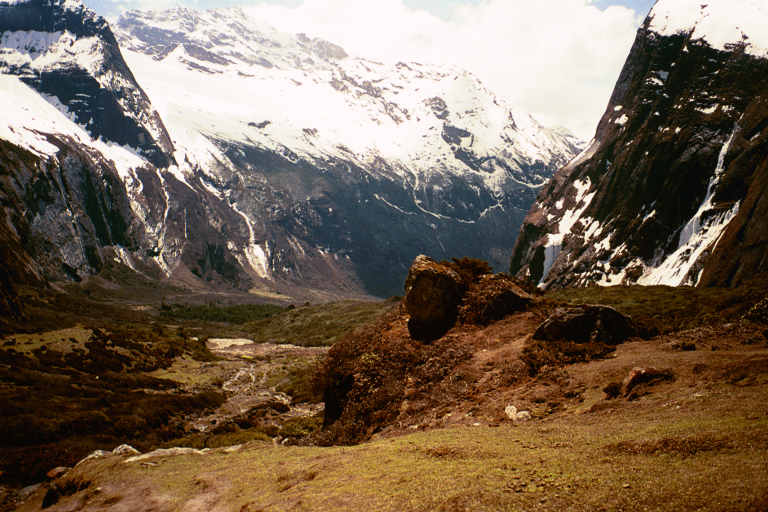
At Yak Kharka the couple were working in their vegetable garden, so I didn't stop for lunch as I intended. Just before the bridge, I met a group of Nepalese who looked as though they may have been returning to their summer/monsoon home.
I met a group of 4 trekkers not long before Mumbuk, one of whom told me "there is some snow on Shipton Pass but it is easy to avoid it". Just before Mumbuk, met a large group of porters going into base camp with almost empty baskets. Arrived at Mumbuk at 5:20pm, but I had taken my time and so was not very tired. Began raining and porters hadn't arrived, so I sheltered in JC's tent. The Sherpa arrived with my sleeping bag about 7pm; the Rai didn't arrive with my tent until 8:20pm --- he had been drinking rukshi with his friends (the large group of porters).
There was a lot of soggy snow, despite what the trekker had told me. Eventually I speeded up, especially when light rain began before I reached Shipton Pass. Slogged on through the snow. Reached Kaungma in about 7 hours, about 5 of which were spent on soggy snow in my light walking shoes. Stopped for tea and biscuits. Left 2:30; down to Tashigaon at 5:20. Rain heavy at times during descent. Met JC in first lodge.
Four leeches had attached themselves to me --- one I removed immediately; the second a kid saw and pulled off me after it had gorged itself; the remaining two had already dropped off leaving a wound. They were the first leeches I'd seen. I didn't find them as disgusting as I feared --- given how overloaded my blood was with red blood cells, losing a little blood would probably do me good.
The Rai porter had to return to base camp with a load of vegetables for the Chileans, so I asked lodge owner to find me a replacement porter to Tumlingtar.
Couldn't find porter to Tumlingtar --- the Sherpas of Tashgaon don't like to work as porters in the hot areas below. Finally, I found one porter who was willing to carry a load to Sedua for me (300R).
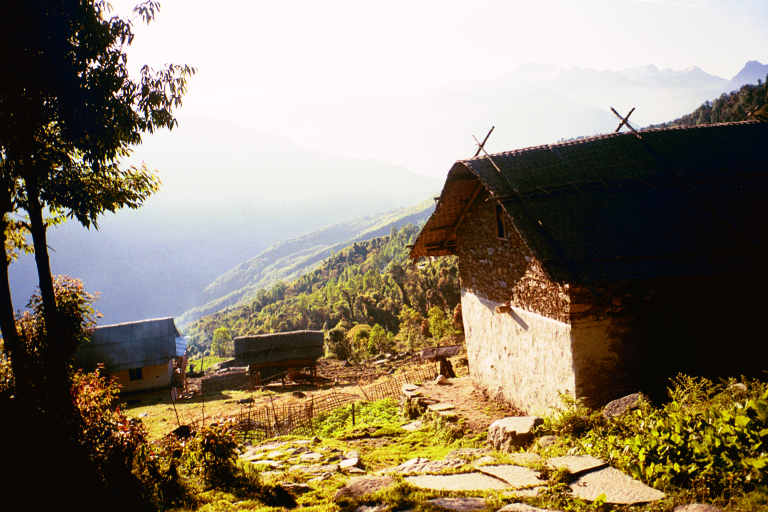
Walked down to Sedua in about 2 3/4 hours. A small black snake slithered across the trail in front of me. After I arrived in Sedua, I had some trouble finding JC and my Tashigaon porter. The first people I spoke to said I wouldn't be able to find a porter to go to Num today, but I did find one (by accidentally offering 1500R ($20) to Tumlingtar whereas standard pay is 1200R). Then my Sherpa porter hobbled in with a sprained ankle, so I needed a second porter. I paid my Sherpa 500R, and he set off to hobble back to his village, 2 days distant. Found second porter --- I think I hired two of the local juvenile delinquents, but they were happy (and good) porters. They had lunch and packed for the trip to Tumlingtar --- one brought nothing but a water bottle (no clothes or money). Left 11am, and reached Num at 4pm. On way saw a young man who had just shot at a bird with a large shotgun. He gave me a dirty look, but I don't think he was a Maoist. It was very tiring climbing the huge number of stone steps from the river to Num in the heat. Had beer. Stayed at Makalu Lodge. Lodge man thought I was 80 years old! (O.K., so may be by now I felt 80 years old, but I don't think I looked it). JC had eaten there and gone onto the next village (Mure). [He was unable to find a place to stay, or even someone to give him a cup of tea, and spent an uncomfortable night in his tent in the rain.] [Unlike me, JC had left his gear at base camp, and so would have to wait in Kathmandu until the rest of the party returned.]
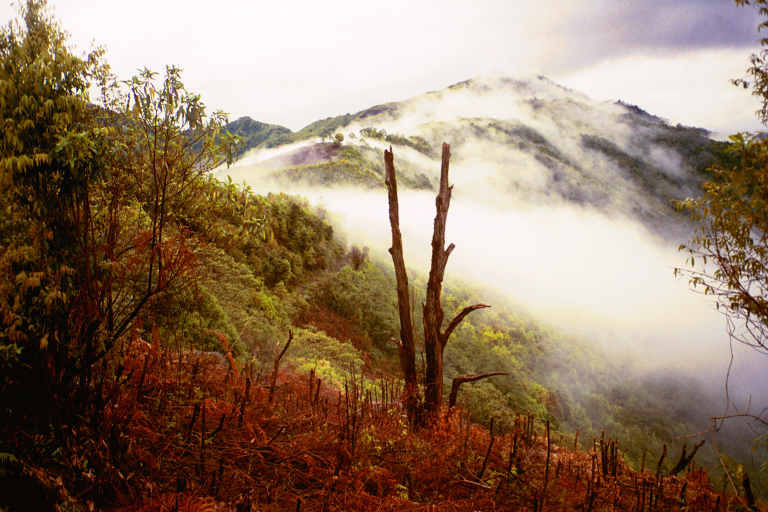
Stopped for lunch at Chichiya, and left at about 1pm. Saw many frogs on the trail. The porters and I descended in heavy rain to Mani Bhanjang, where I stayed in the Everest hotel --- pleasant owner.
He had confirmed that we had reservations on the flight to Kathmandu today, but, because of some mix-up, he hadn't been given the tickets that Wilderness Experience (Adventure Consultant's agent) had sent to the hotel 4 days earlier, and we had to pay the $72 fare. Flew to Kathmandu, and reached Hotel Garuda, where (amazingly!) I was able to change my reservation and get on tomorrow's flight to Bangkok.
14.05.01 Monday, 11:30 a.m.
Good morning from Makalu Base Camp; it is about 11:30. We have got some high cloud cover, I know there are a few people trying to summit today.
This is Robert Stephens by the way. Hamish called yesterday, we were pretty wiped out from our summit attempt, so I know he filled you in a little bit on what happened.
I can go over a few things, and update you on what's happening. Takashi did arrive in to camp about 10 minutes ago; he was suffering from severe snow blindness and had to stay up there an extra day.
Guy came down yesterday, and he is in good shape, as did Dorje and congratulations those three and our team for getting to the summit.
We had seven of us starting out on that day, and as it played out we had two sherpas and Guy, Bruce, Willie, Takashi and myself.
On summmit day (12.05.01) we rose about 1 a.m. and started brewing and getting our gear on. We left camp around 3 a.m. Beautiful morning - about 5 a.m. the sun started to rise, and that was when we lost our first sherpa. He turned around mainly because of cold toes. Unfortunately he had all the fixed ropes for us with him.
As it turns out, that was pretty much my demise, not having those fixed ropes up higher on the mountain.
Let's see, a little bit later - around 7,900 meters, Bruce was also feeling the effects of the cold, and it wasn't his day so he turned around. At around 8,000 meters is pretty much where I decided the safety level and what was going to happen later on in the day - I knew the climbing was going to get more technical and more difficult, obviously, the higher we went, and I just felt without the fixed ropes it was not going to work out for me, so I decided to turn around at that point.
Willie kept going for a while - he turned around around 8,100 meters. About 150 meters above him, Takashi was out in front; he was extremely strong and doing well that day. He triggered an avalance and figured he went down about 50 meters.
That was pretty scary for him. Luckily his good mountaineering instincts - Takashi, quite the seasoned veteran - was able to arrest himself with his ice axe and keep on going. My hat's off to him. At any rate, that was enough for Wille so he turned around at that point.
I got back down to Camp 4 and Bruce was there recovering, and we decided to take off and try to get down to Base Camp. It was around 9 or 10 in the morning, so we packed up our gear there and went down to Camp 3, picked up more of our gear. I took off a little before Bruce.
It was a tough day getting down. There were about 60 mile-per-hour winds right there at the top of that couloir and we felt like we were in kind of a time warp scene in a movie, snow just whipping by your feet.
Anyway, we got down the couloir and, second rope down it was buried probably a foot-and-half - we couldn't even find it, so we had to downclimb without rope for a while, and that was a bit stressful.
A little further down into the couloir we were able to get some ropes and safely able to get down into it and into Camp 2. We found two out of three tents completely destroyed from the wind and snow - completely buried. It was quite a scene, so we dug those out and got the rest of our gear out of there and got back down into Base Camp around 6 p.m.
It was a very stressful day. Still having a lot of emotions about it, and dealing with my own personal disappointment, but I will get over it. It is only a mountain.
We are all very proud that Guy and Takashi and Lhakpa Dorje made it to the summit around 2:30 or 3 p.m. They got down to Camp 4 around 6 or a little bit later.
I know if I had been with them; I was feeling strong, had been on the oxygen and there wasn't a problem health-wise, just the comfort level with the safety factor and going the distance would have been very rough for me and slow going. I am certainly not in their league, and I know my limitations.
Lhakpa Dorje Sherpa was the first person to climb Makalu twice, and Guy was only the second New Zealander to climb it (Rob Hall climbed it in 1995; two expeditions led by Ed. Hillary and one led by Peter Hillary had been unsuccessful). With the exception of the American expedition on the southwest ridge and Spanish expedition on the standard route, most expeditions have put at least a couple of members on the summit. As of 16.05.01, there are two climbers missing on the mountain, presumed dead.
After I returned I did a some research on the effects of high altitude (courtesy of the UMich Medical Library). The literature is vast --- a surprising number of medically trained people have been willing to suffer the hardships and dangers of high altitude climbing to increase scientific knowledge on the effects of high altitude on human physiology.
A major factor in high-altitude deterioration is weight loss. Under
ideal circumstances, 75% of any weight loss is fat, but at high
altitudes (above 5400m) only 25% of weight loss is fat. Dramatic loss of
muscle has been observed. To prevent weight loss, one should eat as much
high-carbohydrate food as possible. At 5800m, switching from a high-fat
diet to a high-carbohydrate diet resulted in a dramatic increase in
arterial oxygen saturation, and in a corresponding improvement in
athletic performance. A low fat diet is recommended because fat is not
absorbed (i.e., it ends up in faeces) and hinders the absorption of
sugars and amino acids.
(Ward, High Altitude Medicine and Physiology, 1995, 3.8.2,
13.8).
The food available to us above base camp (i.e., above 5700m), by my count, consisted of about 600kcal/day of high carbohydrate food (2 small packets of cereal; 2 muesli bars). The rest was either a mixture (e.g., prepared dinners in a bag) or was high-fat (cheese, chocolate coated peanuts, etc.). I lost 15 lbs during the trip, about double what I would expect on a (more) energetic trekking trip of the same length. I was the heaviest of the group. Probably the second heaviest was Bryan and he also suffered a surprising deterioration.
That you should eat only high-carbohydrate low-fat food at high altitudes has been common knowledge among climbers for many years, or at least I thought it was. When I asked Guy why we had so little high carbohydrate food, he said that he brought the food that people had liked to eat, and appeared to be unaware of the research.
If I attempt an 8000m peak again next year, I will be eating dal bhaat (like the sherpas) and granola bars (as on all my other climbs), and I will be following the schedule my body dictates.
The Adventure Consultants site is www.adventure.co.nz
All of Rob's reports can be found at www.modbee.com